
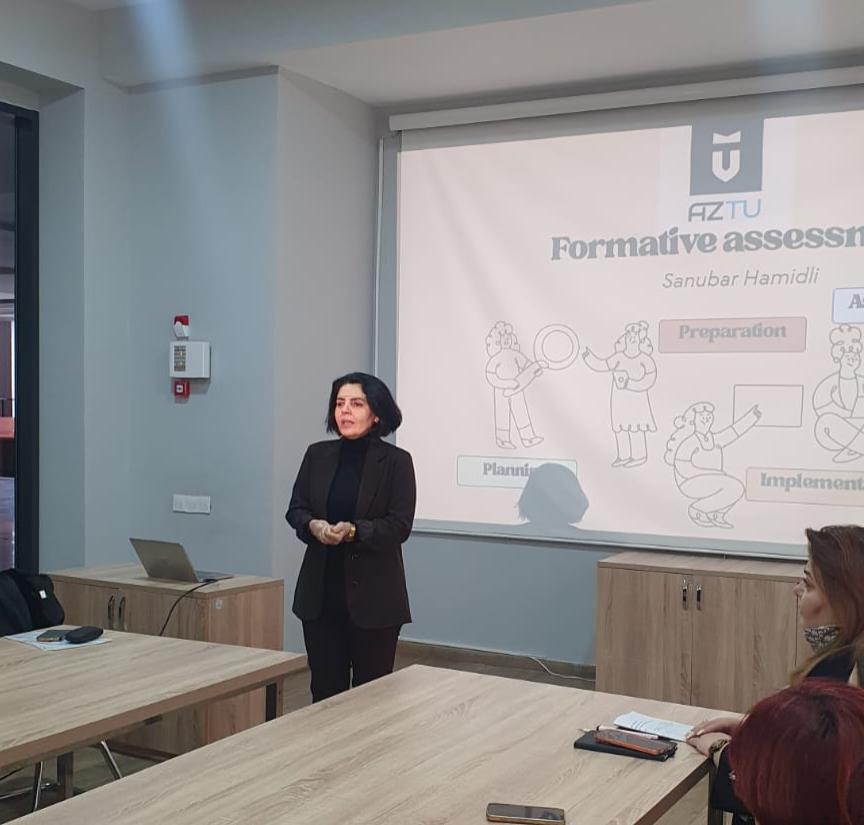
A webinar was held on the topic of “Neuroscientific explanation of language learning” organized by the Department of Foreign Languages of Azerbaijan Technical University (AzTU)
During the webinar, Professor Sabina Almammedova, Head of the Department of Foreign Languages, stated that, as a result of recent research, foreign language learning creates changes in the neural networks of the brain and develops language skills through memory and association mechanisms. She also emphasized the functions of Broca’s and Wernicke’s areas, hippocampus and prefrontal cortex in language perception and production, as well as the effectiveness of brain-based learning approaches (game-based learning, etc.).
At the event, teachers of the department, Sanubar Hamidli, Pakiza Haziyeva and others, made presentations on identifying optimal methods for the development of English language skills and exploring their practical application possibilities, taking into account modern achievements in neurology and cognitive sciences.
In his report, Afag Ismayilzadeh stated that different regions of the brain are involved in the language learning process and presented his scientific research on the important role of neuroplasticity in the acquisition of new languages. He explained that brain-based learning methods, multisensory approaches, neuroplasticity principles, and innovative technologies (artificial intelligence, virtual reality) allow for more effective learning of English.
Keywords: neuroscientific language skills, language learning, innovation, pedagogical approach, new education system, Foreign languages, role of the teacher